

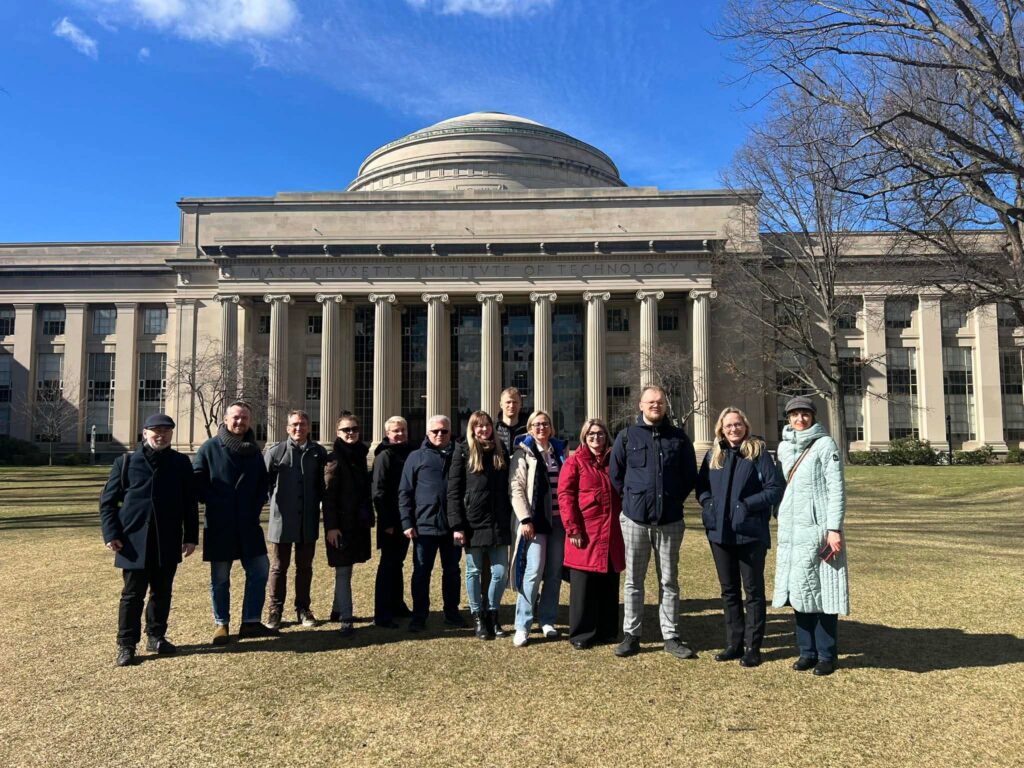
Between March 16 and 20 this year a delegation from the Lithuanian Consortium for Engagement with the Massachusetts Institute of Technology (MIT) carried out its third strategic visit to the United States. The group brought together representatives from Lithuanian universities, research institutes, and businesses, continuing efforts to deepen collaboration with one of the world’s leading innovation ecosystems.
This year’s spring was full of new experiences for the transatlantic science and innovation community. A delegation with 18 members from 13 partnering science and business institutions of Lithuanian Consortium traveled to the world’s leading university to discuss further plans for joint research and projects.
The visit agenda combined joint and individual meetings with MIT representatives. In parallel, the delegation engaged directly with MIT’s academic environment, attending classes, thesis defenses, and midterm project reviews of students at MIT schools and DesignX, dedicated to design innovation and entrepreneurship. These experiences provided first-hand insight into how MIT structures its learning process around active participation and real-world problem-solving.
Reflecting on the visit, Professor Elizabeth Wood—founding director of the MIT-Ukraine Program and co-director of the MIT-Eurasia Program at the MIT Center for International Studies (CIS) —emphasized both the scope of these CIS-affiliated programs and the value of direct exchange:
It was wonderful to have our Lithuanian colleagues from the Consortium visit MIT the week of March 16 as spring was just arriving. We were able to have excellent visits to many facilities at MIT, including meeting with the Vice Provost for International Activities, Duane Boning, and with the head of all the MIT libraries, Chris Bourg.
The visit explored concrete ways to bring researchers and industry closer together, especially how to turn scientific ideas into real products and solutions.
From Process to Impact
Throughout the visit one idea kept coming up repeatedly: research and education are increasingly being judged by the real-world impact they create. According to Professor Wood, the conversations pointed to real changes already happening across Lithuanian universities:
This visit helped me to clarify some of the fascinating directions that Lithuanian leaders in academia and industry are discussing, including moving to modernize and innovate in research and education.
She also pointed to the importance of stronger collaboration between science and business, as well as more practice-oriented teaching models:
I was intrigued by the discussion of building more ties between academia and industry so there can be more mutual support. Some MIT models of teaching that orient courses toward concrete proposals of tasks from the business community might be useful here.
These insights were further reflected in conversations between Lithuanian and MIT representatives. Ina Žurkuvienė, the coordinator of the Lithuanian Consortium, elaborated:
At MIT, there is a strong focus on how research contributes to real change in the world. Their portfolios are built around projects, inventions, and technologies. It raises an important question for us in Lithuania – what if we started measuring success more by impact than by process? While high-quality publications remain a cornerstone of science, broadening our criteria to value real-world outcomes alongside traditional metrics would allow a more holistic appreciation of a scientist’s contribution.
At the same time, it was emphasized that such approaches require careful adaptation to national and European contexts rather than direct replication.
The delegation met with possible partners to discuss these shifts, including Prof. Dr. Phillip Budden—who recently visited Lithuania—and Prof. Dr. Fiona Murray, Vice Chair of the NATO Innovation Fund. Their discussions focused on exploring future avenues for collaboration.
Learning How Innovation Moves Through the Role of MIT Centers
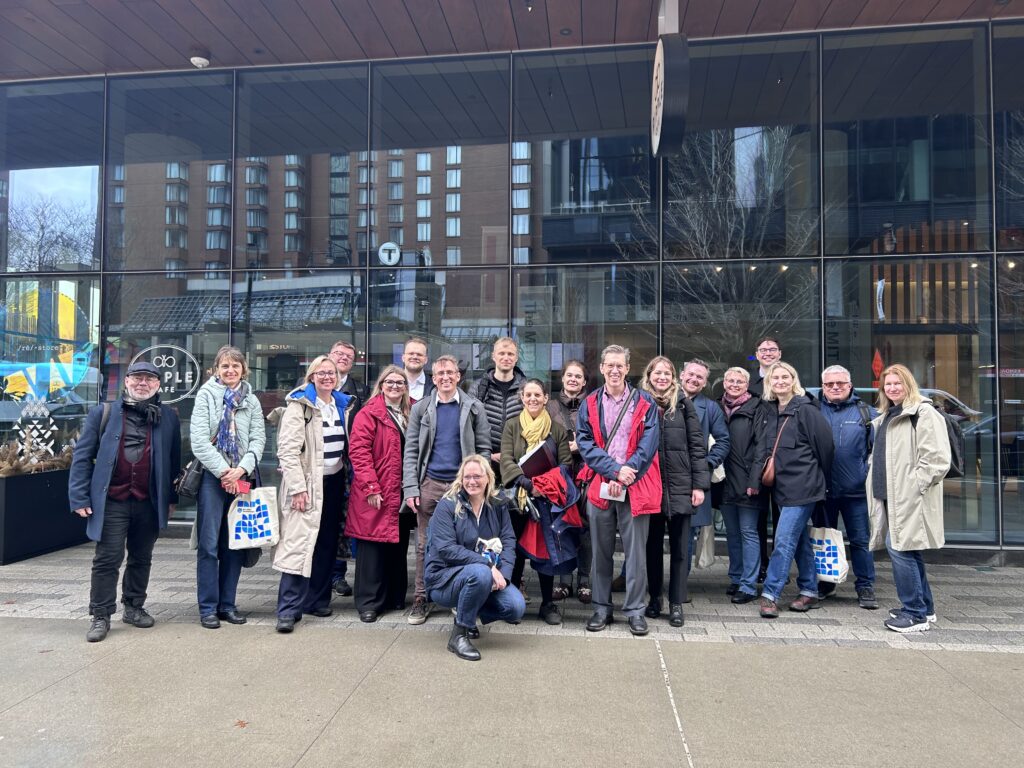
To better understand how ideas move from laboratories to the market, the delegation visited several MIT units, including the Deshpande Center for Technological Innovation.
There, discussions with Executive Director Rana K. Gupta highlighted a highly selective commercialization model. Each year, the center reviews dozens of research proposals but supports only a small number of projects with strong potential for real-world application. A big part of this process relies on ‘Catalysts’ – experienced scientists who work side by side with researchers to test ideas, spot risks early, and help move projects toward the market.
The Consortium’s coordinator stressed that this approach only works when there is a genuine trust between researchers and the people helping bring their ideas to market:
That trust comes from shared experience – without it, even the best tools or processes are not enough.
One more insightful visit was to the MIT Teaching and Learning Lab. It highlighted an approach to education focused on active learning. It was noted that students are expected to engage with theoretical material independently before class, while in-person time is dedicated to discussion, teamwork, and solving real-world challenges. This model is reinforced across MIT through early involvement in team-based projects, close collaboration with faculty and industry, and access to entrepreneurship platforms such as MIT DesignX, combining practical application with a strong interdisciplinary academic foundation.
Testing Ideas in Practice
The delegation also visited the MIT Nuclear Reactor Laboratory, one of the few university-based research reactors in the world. The facility enables advanced materials testing under extreme conditions, significantly accelerating research processes and supporting collaboration with industry partners developing next-generation energy technologies.
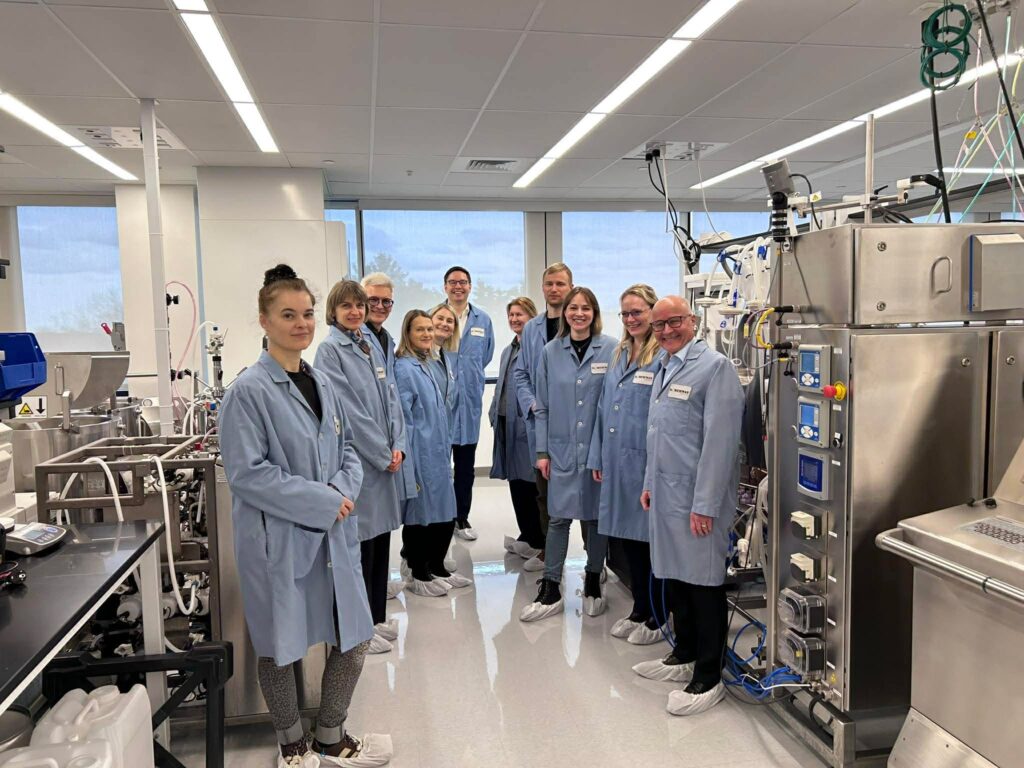
Another important stop was at the Lithuanian-founded biotechnology company Northway Biotech in Waltham, Massachusetts. The tour of modern laboratories highlighted how the manufacturing technologies for biological medicinal products are developed and medicinal products are produced for clinical trials.
The new member of the Consortium is continuing talks with Lithuanian Science institutions about a possible collaboration for building the joint Research and Innovation Centre for biotechnologies. The Center is primarily defined by its explicit focus on dual-use research. Idea was presented in a meeting with Prof. Dr. Robert Desimone, Dr. J. Christopher Love, Prof. Dr. Michael J. Cima, Prof. Dr. Hadley Sikes who was a guest speaker at the conference Human and More than Human Futures organized by the Lithuanian Consortium last October.
Building the Momentum
The engagement between Lithuanian institutions and MIT is already yielding concrete results. In the first year of collaboration, Lithuanian participants submitted seven MIT Global Seed Funds applications—administered through CIS—together with MIT researchers.
Another tangible outcome is a planned joint academic micro-module under development by 6 Lithuanian universities, scheduled to launch in October 2026. The pilot initiative will connect students from Lithuanian universities with MIT’s academic environment through MITx and teaching practices.
Reflecting on the broader exchange, Professor Wood also highlighted the mutual learning dimension of the visit:
I also learned a lot about Lithuanian self-reliance and independence in conversations with members of the delegation. Overall, it was a fascinating and fruitful set of meetings and discussions. I’m delighted that so many wonderful colleagues were able to come to visit.
Summarizing the experience, participants emphasized that MIT’s model should be seen as a source of inspiration rather than a blueprint.
MIT’s environment is unique. You cannot simply transfer it to another system, Ina Žurkuvienė noted. Not all science needs to become business, but where it does, it requires strong support. This is a broader systemic question – but it is one worth exploring.
Special thanks to Gediminas Urbonas, Deliana Ernst, Ekaterina Zabrovski for making this visit so enriching.
About the Consortium
The Lithuanian Consortium for Engagement with MIT brings together leading Lithuanian universities, research institutions, and companies, including Euromonitor International, Ignitis Group, Lithuanian Research Centre for Agriculture and Forestry, Lithuanian Railways, Lithuanian Energy Institute, Klaipėda University, Kaunas University of Technology, Mykolas Romeris University, Northway Biotech, Novian, Vytautas Magnus University, Vilnius TECH, Vilnius University, and Vilnius Academy of Arts.
Coordinator of the Consortium – Vytautas Magnus University.
Consortium activities are supported by the Research Council of Lithuania.