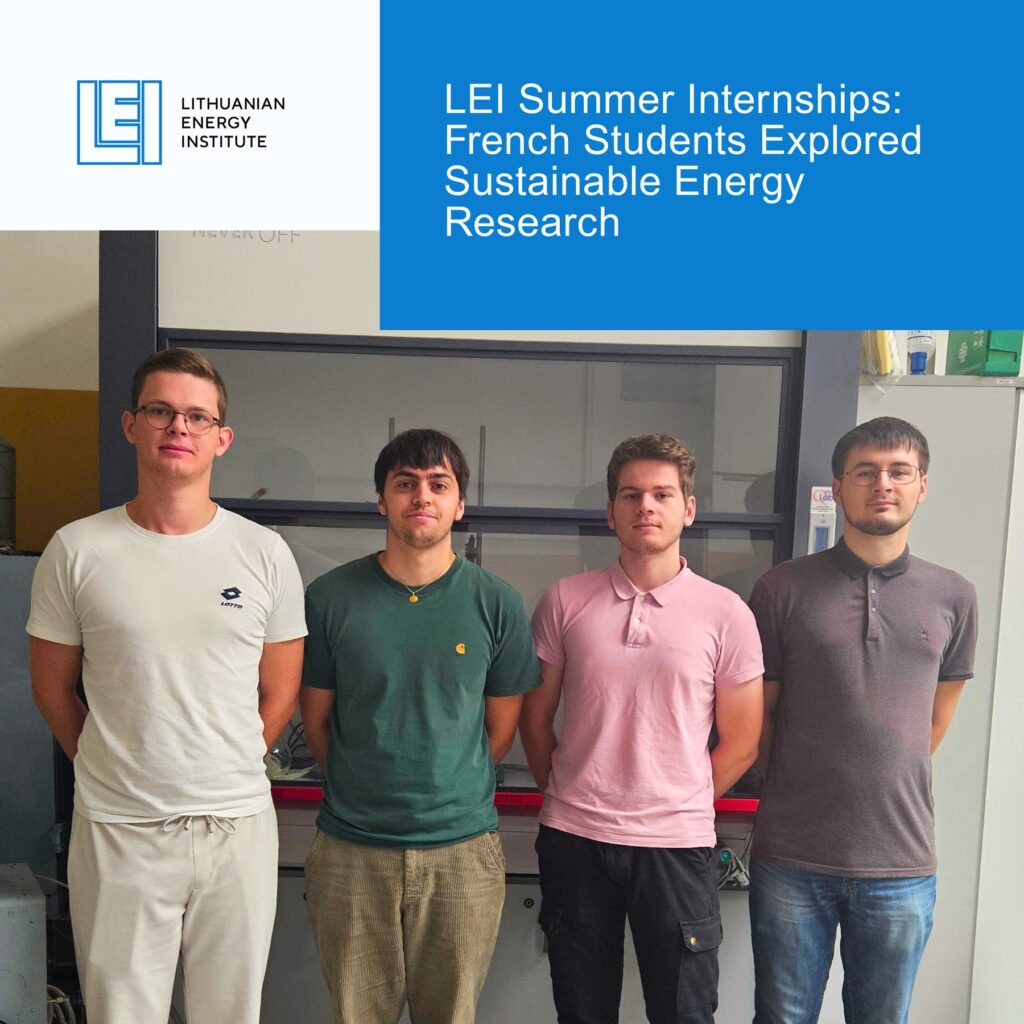


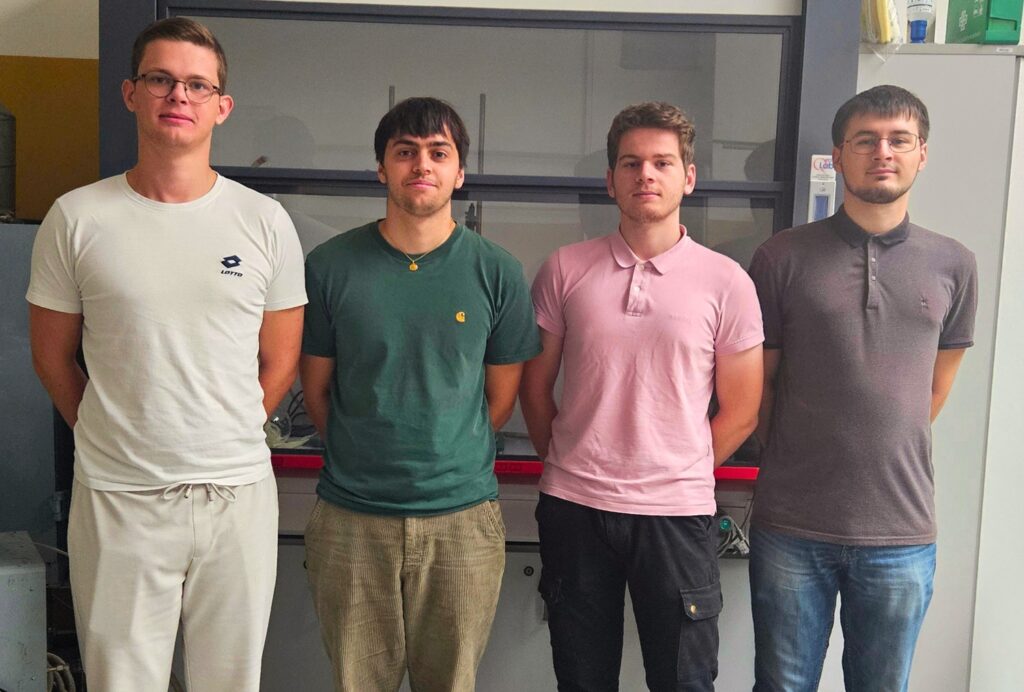
This summer, five engineering students from France completed internships at the Laboratory of Combustion Processes of the Lithuanian Energy Institute (LEI) – Basile Guivarch, Thomas Garbaciak, Thomas André Bernard Pinaud, Maxime Rault and Matthys Beaugendre. Through the Erasmus+ mobility programme, they arrived in Lithuania from the University of Pau and Pays de l’Adour (Université de Pau et des Pays de l’Adour) and the University of Orléans (Université d’Orléans). During their internships, the students contributed to research on combustion technologies, syngas cleaning and the utilisation of landfill gas, while gaining valuable international research experience.
The students are studying different fields of engineering, but they are all united by their interest in sustainable energy technologies and their desire to apply the theoretical knowledge gained during their studies in a real research environment.
Discovering LEI’s Research Opportunities
Although the students followed different paths before arriving at LEI, they were all attracted by the research carried out at the institute and the opportunity to contribute to ongoing scientific projects and the development of sustainable energy solutions. Some of them found the internship opportunities independently while searching for options abroad, while others learned about LEI through their university professors.
B. Guivarch explains that while searching online for a possible internship, he discovered the Combustion Processes Laboratory at LEI and decided to contact the researchers working there. He became interested in the laboratory’s research activities and the opportunity to work with combustion processes and plasma technologies.
For M. Beaugendre, the decision to come to LEI was influenced by his previous experience in Lithuania. He had spent several months studying in Vilnius University through the Erasmus programme, so he decided that completing his internship in Lithuania would also be a great opportunity. He learned about the possibility of joining LEI from one of his university professors.
“I had already spent several months in Lithuania, and I really liked it here, so I thought it would be a good idea to complete my internship in this country as well. One of my lecturers suggested that I look into internship opportunities at LEI, so I contacted the institute,” he says.
T. Garbaciak says that he wanted to complete his internship in one of the Nordic countries. While searching online, he discovered LEI and learned more about the research carried out at the Combustion Processes Laboratory, which appeared to be closely related to his studies. He also shared the opportunity with his classmates T. A. B. Pinaud and M. Rault.
“I also found an article on the institute’s website about other students from France who had completed their internships here the previous summer. We thought – if LEI had already welcomed French students, maybe we could try as well. Perhaps next year French students will read an article about us and decide to come to LEI too,” T. Garbaciak says with a smile.
Research for a More Sustainable Future
During their internships, the students worked on several different research projects carried out at LEI. Some of them investigated the application of plasma technologies in combustion processes and contributed to the development of fuel-flexible burner technologies for glass-melting furnaces, while others focused on finding efficient solutions for syngas purification and analysing the potential use of landfill gas for energy production.
Working in the laboratories, the students not only carried out experiments but also analysed the collected data, became familiar with research planning processes and learned how to operate modern laboratory equipment. They used a gas chromatographs (GC), an FTIR analysers and other instruments that allow researchers to evaluate gas composition and analyse the processes taking place.
According to the students, many of the research methods were familiar from their university courses; however, the internship gave them the opportunity to apply this knowledge independently for the first time.
Process engineering students T. Garbaciak and T. A. B. Pinaud were pleased to contribute to the development of more sustainable syngas technologies. During their internship, they investigated how unwanted compounds can be removed from syngas by using different materials and evaluating their efficiency. According to the students, such solutions could contribute in the future to reducing the use of fossil fuels in the chemical industry and energy sector.
The students say that this work helped them better understand processes that they had previously encountered mainly during their studies.
“At university, we learned about many of these methods theoretically, but it is completely different when you perform the experiment yourself, analyse the results and understand why they turn out the way they do. This kind of experience helps to understand the topics covered during studies much better,” says T. Garbaciak.
During their internships, M. Beaugendre and B. Guivarch worked on the application of plasma technologies in combustion processes. According to B. Guivarch, the opportunity to gain a deeper understanding of this process was one of the most interesting aspects of the internship. The student explains that before arriving at LEI, he had limited knowledge of plasma technologies, so the opportunity to see in practice how plasma can be used in combustion processes became one of the most memorable experiences.
Meanwhile, M. Rault contributed to the LoCaGas project, in which a team of researchers investigates the possibilities of using landfill gas for energy production. During his internship, the student analysed whether gas streams with lower methane concentrations could still be used for energy generation.
Discovering Lithuania
Some of the French interns had already visited Lithuania before coming to LEI. B. Guivarch studied at Kaunas University of Technology through the Erasmus programme, while M. Beaugendre spent five months studying in Vilnius University. For the other students, the internship at LEI became their first opportunity to discover Lithuania. All of them agree that the country left a positive impression.
Kaunas appeared to the French students as a convenient, well-organised and student-friendly city. They appreciated the well-developed public transport system, the possibility of easily reaching different parts of the city and the infrastructure available for active leisure activities, including sports facilities and other recreational spaces.
“Lithuania is a very convenient place to live. Everything is easy to reach, the city is clean and beautiful, and everyday life is very comfortable for students,” B. Guivarch shares his impressions.
The students also appreciated the welcoming atmosphere at LEI. According to them, the researchers working at the institute are willing to share their knowledge and experience and provide valuable advice. This support helped the students adapt to laboratory activities more quickly, feel more confident when carrying out practical tasks, deepen their professional knowledge and gain valuable experience.
An Experience That Builds the Future
The students’ future plans vary – some of them would like to work in the energy or engineering sectors, while others see themselves pursuing careers in large industrial companies. Although not all of them have made a final decision about their future career path, they agree that the internship at LEI helped them apply the theoretical knowledge gained during their studies in real-life situations, better understand engineering processes and develop new skills in working with laboratory equipment and analysing data.
The students also recommend LEI internships to other students. According to them, the institute brings together experienced researchers, the laboratories are modern, and the working environment is very friendly. For the students from France, the internship at LEI provided not only professional knowledge and practical skills but also an opportunity to experience another culture and work in an international research environment.